Types of Packaging Materials, Shapes, and Boxes: The Complete Business Guide
Packaging is no longer just a protective layer. It is a strategic business asset that directly impacts branding, logistics, customer perception, and conversion rates. For modern businesses especially small and scaling brandsunderstanding packaging materials, packaging shapes, and types of packaging boxes is critical to making profitable decisions.
This guide breaks down everything from fundamentals to advanced strategies so you can choose packaging that performs across protection, cost, and marketing.
What Are Packaging Materials?
Packaging materials refer to the physical substances used to contain, protect, and present products. These materials define durability, sustainability, cost, and overall brand positioning.
At a basic level, packaging materials serve three functions: Protection during storage and shipping ,Preservation of product quality ,Communication of brand identity. For businesses exploring scalable solutions, working with professional providers like <a href=”https://customdesignpackaging.com/custom-packaging-companies/”>custom packaging companies</a> ensures alignment between material selection and business goals.
Why Choosing the Right Packaging Material Matters
Many businesses underestimate how much packaging influences revenue. The right choice affects everything from shipping costs to customer retention.
Product Protection and Damage Reduction
Fragile items require shock-absorbing materials, while food products demand moisture-resistant packaging. A mismatch leads to returns, refunds, and reputational damage.
For example, when shipping delicate items, using techniques from <a href=”https://customdesignpackaging.com/packing-glass-for-shipping/”>packing glass for shipping</a> can significantly reduce breakage rates.
Cost Efficiency and Logistics
Material weight and volume directly impact shipping expenses. Lightweight materials like corrugated cardboard reduce costs without sacrificing strength.
Understanding structural efficiency is easier with a resource like the <a href=”https://customdesignpackaging.com/corrugated-boxes-guide/”>corrugated boxes guide</a>.
Brand Perception and Customer Experience
Premium materials like rigid boxes elevate perceived value, while eco-friendly packaging appeals to sustainability-conscious consumers.
Sustainability and Compliance
Regulations and consumer expectations are pushing businesses toward recyclable, biodegradable, and reusable materials. Explore sustainable strategies in <a href=”https://customdesignpackaging.com/eco-friendly-cosmetic-packaging-ideas/”>eco-friendly cosmetic packaging ideas</a>.
Main Types of Packaging Materials
Paper and Cardboard Packaging
Paper-based packaging is one of the most widely used solutions due to its affordability, flexibility, and ease of customization. It works well for both small businesses and large-scale operations, offering a balance between cost and performance. Brands commonly rely on solutions like retail boxes to combine visual appeal with practical functionality.
Key Characteristics
Paper and cardboard packaging is lightweight, which helps reduce shipping costs while maintaining adequate protection. It is highly customizable, allowing businesses to print branding, colors, and product information بسهولة. In addition, it is recyclable and eco-friendly, making it a preferred choice for sustainability-focused brands.
Common Use Cases
This material is commonly used across retail packaging, food boxes, and shipping cartons. Its adaptability makes it suitable for industries ranging from cosmetics to food and eCommerce.
Corrugated Packaging
Corrugated packaging is engineered with fluted layers sandwiched between linerboards, providing superior strength and durability. It is specifically designed to handle pressure, stacking, and long-distance shipping without compromising product safety.
Advantages
The material offers a high strength-to-weight ratio, meaning it is strong without adding excessive shipping weight. It performs exceptionally well in transit, protecting products from damage. Additionally, it can be customized in different thickness levels depending on the product’s fragility and shipping requirements.
Applications
Corrugated packaging is essential for eCommerce businesses, bulk shipments, and logistics operations where durability and reliability are critical.
Plastic Packaging
Plastic packaging continues to be widely used because of its flexibility, durability, and resistance to moisture. It is particularly effective for products that require airtight or waterproof protection.
Types of Plastic
Common types include PET, which is often used for transparent containers; HDPE, known for its rigidity and strength; and LDPE, which is typically used for flexible films and wraps.
Considerations
While plastic offers excellent protection for moisture-sensitive products, it raises environmental concerns due to limited biodegradability. Businesses must weigh performance benefits against sustainability goals when choosing plastic packaging.
Glass Packaging
Glass is premiuGlass Packaging
Glass packaging is a premium option known for being non-reactive, durable, and reusable. It is ideal for products where maintaining quality and appearance is critical.
Benefits
Glass preserves product integrity by preventing contamination or chemical reactions. It also enhances the luxury appeal of products, making it a preferred choice for high-end cosmetics and gourmet foods. Additionally, glass is fully recyclable, supporting eco-friendly packaging initiatives.
Common Use Cases
Glass is widely used in cosmetics and food industries. A popular example is perfume packaging, where both protection and presentation are key.
Metal Packaging
Used for industrial and food-grade applications.
Features
- High durability
- Excellent barrier properties
- Long shelf life
Biodegradable and Sustainable Materials
Sustainability is no longer optional.
Popular Options
- Kraft paper
- Mushroom packaging
- Cornstarch-based plastics
Businesses adopting eco-friendly packaging gain both compliance and brand advantage.
Types of Packaging Based on Function
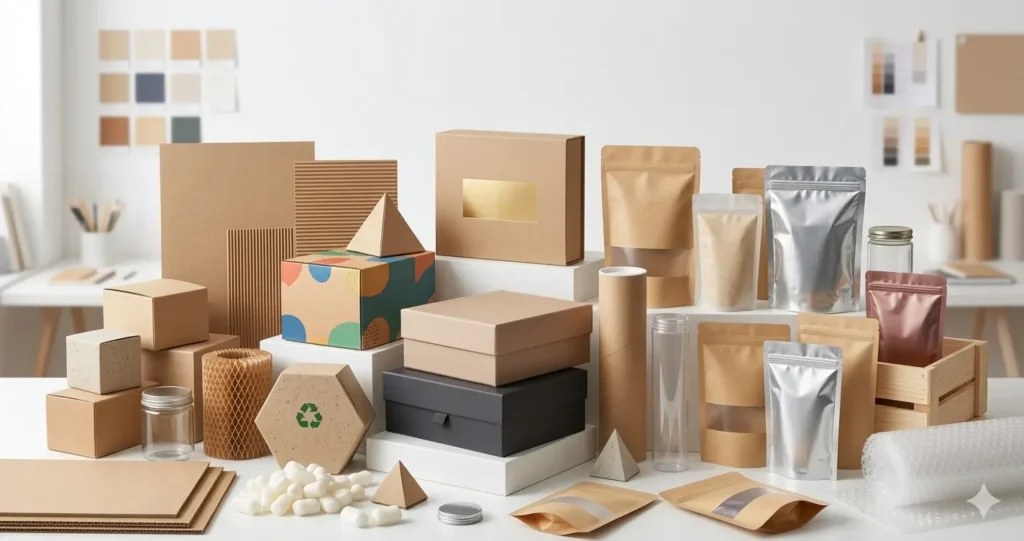
Packaging materials protect, present, and transport products while affecting cost and branding. Common types include paper and cardboard (lightweight and recyclable), corrugated boxes (strong for shipping), plastic (flexible and moisture-resistant), glass (premium and reusable), metal (durable), and biodegradable options like kraft paper. Packaging also serves functions: primary holds the product, secondary groups items—like cosmetic boxes and tertiary handles bulk shipping
Packaging Shapes: How Structure Impacts Performance
Packaging shape plays a critical role in usability, shelf appeal, and shipping efficiency.
Rectangular Packaging
Packaging materials protect, present, and transport products while influencing cost and branding. Common types include paper and cardboard (lightweight, recyclable), corrugated boxes (strong for shipping), plastic (flexible, moisture-resistant), glass (premium, reusable), metal (durable), and biodegradable options like kraft paper. Packaging also serves functional roles: primary holds the product, secondary groups items like cosmetic boxes and tertiary supports bulk shipping.
Packaging Shapes
Packaging shape affects usability, display, and shipping efficiency. Rectangular boxes are common for easy stacking and cost-effective shipping. Square, cylindrical, or custom shapes improve product visibility and branding while keeping items safe.
Types of Packaging Boxes
Understanding box styles is essential for product compatibility and branding. For a detailed breakdown, see <a href=”https://customdesignpackaging.com/types-of-packaging-boxes/”>types of packaging boxes</a>.
Popular Packaging Box Types
Tuck-end boxes are widely used in retail, available in straight and reverse tuck end variations, ideal for lightweight products like cosmetics. Mailer boxes are common in eCommerce, featuring self-locking designs, durable structures, and no adhesive requirement. Rigid boxes provide a premium option for luxury products, electronics, and gifts, delivering a high-end unboxing experience. Corrugated shipping boxes come in single, double, and triple wall strengths for reliable logistics. Gable boxes, recognized by built-in handles, are popular for food and gift packaging.
Specialty and Display Packaging
Display boxes are designed for in-store presentation, such as display boxes that enhance visibility. Sleeve packaging offers a minimalist, cost-efficient solution, often paired with inner trays for added protection. Window boxes feature transparent panels, perfect for showcasing products like bakery items via bakery boxes.
Industry-Specific Packaging Solutions
Different industries need tailored packaging. Food packaging prioritizes hygiene and moisture resistance, including cake boxes, snack packaging, and ice cream containers (ice cream packaging ideas). Cosmetic packaging focuses on aesthetics and trust, with guidance in luxury cosmetics packaging design. Medical packaging demands compliance and safety, explored in medical boxes. Retail and eCommerce require durable, branded packaging like retail boxes printintomdesignpackaging.com/calculate-your-custom-packaging-roi/”>packaging ROI calculator</a> to measure impact.
Cost Factors in Packaging Materials
Packaging costs vary based on:
- Material type
- Box style
- Printing complexity
- Order volume
For detailed insights, visit <a href=”https://customdesignpackaging.com/how-much-does-custom-packaging-cost/”>custom packaging cost guide</a>.
Packaging Trends Businesses Should Know
Sustainable Packaging
Demand for eco-friendly solutions is growing rapidly.
Minimalist Design
Clean, simple packaging improves brand perception.
Smart Packaging
Includes QR codes and interactive elements.
Customization at Scale
Advancements allow small businesses to access premium packaging.
Request samples via <a href=”https://customdesignpackaging.com/free-packaging-design-samples-before-bulk-orders/”>free packaging design samples</a> before bulk production.
FAQ Section (Schema-Ready)
What are the most common packaging materials?
The most common materials include paperboard, corrugated cardboard, plastic, glass, and metal. Each serves different purposes based on product requirements.
What is the best packaging for small businesses?
Corrugated boxes and paperboard packaging are ideal due to affordability, customization, and durability.
How do I choose the right packaging box?
Consider product size, fragility, branding needs, and shipping conditions. Matching box style to product function is essential.
What packaging is eco-friendly?
Kraft paper, biodegradable plastics, and recyclable cardboard are among the most sustainable options.
What is the difference between primary and secondary packaging?
Primary packaging directly contains the product, while secondary packaging groups products and enhances presentation.
Conclusion
Packaging is a strategic lever that influences cost, branding, customer experience, and operational efficiency. Businesses that invest in the right packaging materials, optimize packaging shapes, and select appropriate box types gain a competitive edge.Whether you are launching a new product or scaling operations, the key is to align packaging decisions with long-term business objectives. Thoughtful packaging not only protects products but also builds trust, enhances perception, and drives conversions.
If you are evaluating packaging solutions, start by exploring tailored options and consulting experts through <a href=”https://customdesignpackaging.com/get-free-consultation/”>free packaging consultation</a> to ensure your packaging works as a growth driver rather than just a cost center.